
Note FX
Arp
General information
Arp is a tempo-synced arpeggiator that turns held notes into a sequence. The pattern can run in 7 directions, span up to 6 octaves, swing on the off-beat, ratchet (1 to 4 sub-pulses per step), drop notes probabilistically, and follow a rhythm pattern generated by one of 6 algorithms (Euclidean, Fibonacci, Golomb, Aksak, Binary, Turing) plus a Manual mode.
The arpeggiator is always synced to the project clock — it does not free-run. The clock division (from 1/64 up to 1 bar) sets the step rate.
The Note FX has 4 tabs: PLAY (mode / hold / octave range / advance), SCALE (transpose / scale / root), TIMING (clock rate / gate length / swing / ratchet / probability) and RHYTHM (rhythm algorithm and pattern length).
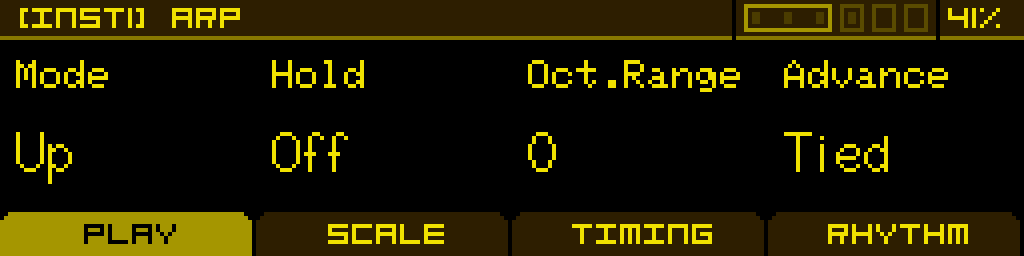
PLAY tab
| Mode | Hold | Oct.Range | Advance |
| Direction the arpeggiator walks through the held notes. 7 modes: Up, Down, Up/Down, Down/Up, As Played, Shuffle (random permutation cached per cycle), Random (per-step random note + octave). | Off: notes leave the held list when the gate falls. On: notes stay held after release; the arpeggio keeps running until you release Hold or replace the chord with a new one. | Number of octaves the pattern spans, from -3 to +3 (default 0 = single octave, no octave shifting). | Step advance rule: Tied — the note pointer moves with every clock step (rhythm gates choose which steps are silent). Free — the note pointer only advances on rhythm hits (silent steps don't consume notes). |
SCALE tab
| Transpose | Scale | RootNote | |
| Global semitone offset (-48 to +48). | Scale to quantize the arpeggio output (same 18-scale list as on the Note page). Off leaves the held notes chromatic. | Root note of the scale (12 chromatic notes). |
TIMING tab
Two pages.
Page 1
| ClockRate | Length | Swing | Ratchet |
| Step rate as a clock division: 1/64, 1/32, 1/16 (default), 1/8, 1/4, 1/2, 1 bar. Determines how many steps fit in one beat / bar. | Gate length of each step as a percentage of the step duration (1–100%, default 75%). | Swing amount applied to off-beat steps (0–50%). At 0 every step is evenly spaced; at 50% the off-beat is delayed by half the step length. | Number of repeats per step: 1, 2, 3, 4. With 2+, each step fires that many sub-pulses with the same note. |
Page 2
| Prob. | |||
| Probability that each step actually plays (0–100%, default 100%). At lower values the arpeggio drops random steps for a sparser, evolving feel. |
RHYTHM tab
| Algo | Param1 | Param2 | Length |
| Selects the rhythm algorithm that gates which steps actually trigger: Off (every step plays), Euclid, Fibonacci, Golomb, Aksak, Binary, Turing. | First control of the active algorithm (1–32). Meaning depends on the algorithm: hits, density, preset selector, seed… | Second control of the active algorithm (0–31). Meaning depends on the algorithm: rotation, spread, lock/chaos… | Pattern length: Auto (matches the held-note count) or 1–32 steps. The arpeggiator advances its note pointer through the pattern according to Advance mode. |
The rhythm algorithms are the same family used by the dedicated Rhythm Generator Note FX — see that page for the per-algorithm behaviour of Param1 and Param2.
Tip: combine Hold = On with Probability < 100% and a low-density Euclidean rhythm for evolving, generative arpeggios that keep playing after you release the keys.