
Note FX
Chords
General information
Chords turns a single input note into a chord of up to 6 voices. Two operating modes:
- Diatonic mode — picks notes from a selected scale starting on a chosen scale degree (I to VII).
- Predef. mode — uses one of 26 predefined chord types (major, minor, sus2, 7th, 9th, 11th, 13th, altered…).
In both modes, the chord can be inverted, voiced wider or tighter, dropped (Drop2/Drop3 voicings), and strummed with humanised timing for a more natural feel. Setting the Density parameter higher than 1 spreads the chord across multiple voices of the instrument.
The Note FX has 4 tabs: CHORD (chord building), SCALE (transpose / scale / root note), VOICING (density / spread / legato / glide) and STRUM (timing / direction / humanization).
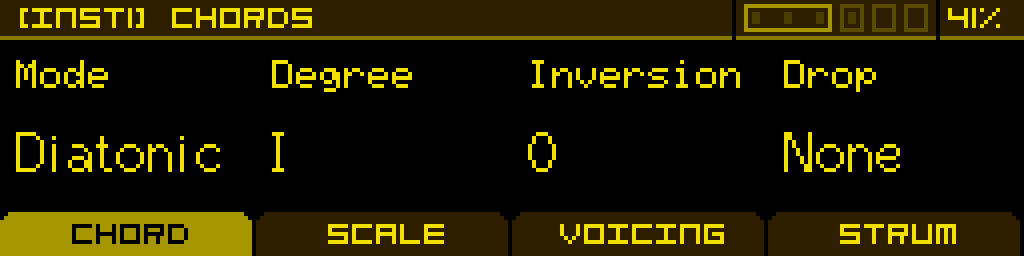
CHORD tab
The second button changes with the chord Mode: Degree in Diatonic mode, Type in Predef. mode.
| Mode | Degree (Diatonic) · Type (Predef.) | Inversion | Drop |
| Selects the chord-building mode: Diatonic (chord built from the selected scale) or Predef. (one of 26 predefined chord types). | In Diatonic mode: chord degree from the scale (I, II, III, IV, V, VI, VII). In Predef. mode: the chord type (see Chord types below). | Chord inversion: 0 (root position), 1 (1st inversion), 2 (2nd inversion), 3 (3rd inversion). | Voicing: None (default), Drop2 (2nd note from top dropped one octave), Drop3 (3rd note from top dropped one octave). |
Chord types (Predef. mode)
| Family | Types |
| Powerchord / Sus | 5, sus2, sus4 |
| Triads | maj, min, dim, aug |
| Sixths | 6, m6 |
| Sevenths | 7, maj7, m7, m7b5 |
| Ninths | 9, maj9, m9 |
| Elevenths | 11, maj11, m11 |
| Thirteenths | 13, maj13, m13 |
| Altered sevenths | 7b9, 7#9, 7#11, 7b13 |
SCALE tab
| Transpose | Scale | RootNote | |
| Global semitone offset (-48 to +48) applied to the whole chord. | The scale used in Diatonic mode (see the Scale list on the Note page). Default is Pent.Min.. | Root note of the scale (12 chromatic notes). |
VOICING tab
| Density | Spread | Legato | Glide |
| Number of notes in the chord (1 to 6). Limited at runtime to the instrument's voice count — extra voices stay silent. | Octave spread of the chord voices (-24 to +24 semitones). At 0 the chord is tightly voiced; raising it spreads the voices across a wider octave range; negative values pull voices down by octaves. | When On, holding the input gate and changing the input pitch updates the chord notes without retriggering. When Off (default), every new input pitch retriggers the chord. | Glissando time between successive chords (0 – 1024 ms, modulatable). At 0 the chord changes instantly; raise it and every chord voice slides to its new pitch. Pairs naturally with Legato for smooth voice-leading. |
STRUM tab
| Time | Direction | Length | Humanizer |
| Delay between successive note attacks across the chord, 0 to 500 ms. At 0 the whole chord triggers simultaneously; raise it to spread the attacks like a strum or arpeggio. | Strum order: Up (lowest first), Down (highest first), Alternate (alternates direction on each new chord), Random. | Gate length of each note as a percentage of the strum delay (0–100%). At 95% or higher the gate is held until the next chord change ("infinite" gate). | Adds randomness to strum timing and per-note velocity (0–100%). At 0 the strum is perfectly even; higher values introduce subtle imperfections for a more human feel. |