
Note FX
Rhythm Generator
General information
Rhythm Gen is an algorithmic step sequencer that generates note triggers from a rhythm pattern. Up to 16 patterns can be stored per slot and chained into a sequence (forward, reverse, ping-pong or random). Each pattern is up to 32 steps and is built by one of 7 algorithms — Euclidean, Fibonacci, Golomb, Aksak (15 Balkan / Turkish presets), Binary, Turing (LFSR-based looping random) or Manual (hand-edited grid).
It is always tempo-synced to the project clock; the clock division sets the step rate. Three trigger modes change how the rhythm reacts to incoming notes.
The Note FX has 3 tabs: PATTERN (algorithm and pattern shape), PLAY (multi-pattern sequencing and trigger behaviour) and TIMING (clock rate / gate length / swing / probability).
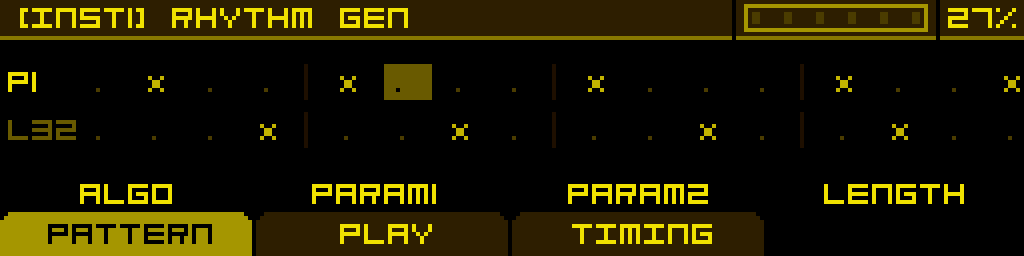
PATTERN tab
The PATTERN tab is where you build the active pattern. Use the encoder to navigate steps; in Manual algorithm a long-press on the encoder enters step-edit mode where pressing the encoder toggles the highlighted step.
| Algo | Param1 | Param2 | Length |
| Selects the algorithm used to generate the pattern: Manual, Euclid, Fibonacci, Golomb, Aksak, Binary, Turing. See Algorithms below for the meaning of each. | First control of the active algorithm (1–32). Meaning depends on the algorithm. | Second control of the active algorithm (0–31). Meaning depends on the algorithm. | Pattern length in steps (1–32, default 16). |
Algorithms
| Algo | Param1 | Param2 | Description |
| Manual | — | — | You toggle each step by hand. Long-press the encoder on the PATTERN tab to enter edit mode. |
| Euclid | Hits (1–32) | Rotation (0–31) | Bjorklund algorithm — distributes the hits as evenly as possible across the pattern length. |
| Fibonacci | Hits (1–32) | Spread (0 = pure φ, 31 = uniform) | Hits placed using the golden-ratio (φ-1 ≈ 0.618) point distribution. Param2 blends towards a uniform spacing. |
| Golomb | Hits (1–32) | Spread (0 = pure Golomb, 31 = uniform) | Maximally uneven (quadratic) spacing — the opposite of Euclidean. Param2 blends towards uniform. |
| Aksak | Preset (0–14) | Rotation (0–31) | 15 traditional Balkan / Turkish asymmetric rhythms (5/8, 7/8, 9/8, 11/8, 13/8, 15/8 plus Ruchenitza, Karsilama, Lesnoto, Kopanitsa, Buchimish). |
| Binary | Density (1–32) | Spread (0–31) | Evenly-spaced hits with a configurable timing offset variation. |
| Turing | Seed (0–255) | Lock / chaos (0 = locked loop, 31 ≈ 50% bit flip) | 16-bit LFSR-based looping random sequencer (inspired by the Music Thing Modular Turing Machine). The lock parameter controls how often bits are flipped — 0 keeps the same loop forever, higher values introduce mutations. |
PLAY tab
Two pages.
Page 1
| Pat.Nb | Pat.Dir | Pat.Start | Trig.Mode |
| Number of patterns chained in the sequence (1–16). Each pattern is stored in its own slot and can have its own algorithm. | Order in which the chained patterns play: Forward, Reverse, PingPong, Random. | Index of the first pattern in the sequence (0–15). | How the rhythm reacts to incoming notes: Free — the pattern plays continuously, ignoring input gates. Gate — the pattern only plays while a note is held; the input gate triggers the rhythm. Filter — incoming notes are passed through only on rhythm hits; misses repeat the previous note. |
Page 2
| V.Offset | |||
| When On (and Trig.Mode is Gate), the pattern is offset by a different number of steps for each voice of the instrument — useful for layered, polyrhythmic patches. Off by default. |
TIMING tab
| ClockRate | Length | Swing | Prob. |
| Step rate as a clock division: 1/64, 1/32, 1/16 (default), 1/8, 1/4, 1/2, 1 bar. | Gate length of each triggered step as a percentage of the step duration (1–100%, default 75%). | Swing applied to off-beat (odd-numbered) steps (0–50%). 0 = perfectly even; 50% = off-beat delayed by half the step. | Per-hit probability (0–100%, default 100%). At lower values the rhythm drops random hits for a sparser, evolving feel. |
Tip: with Trig.Mode = Filter the Rhythm Generator becomes a gate filter — incoming notes are only allowed through on hits of the rhythm pattern. Pair with a melody played on a keyboard to chop it into a rhythmic figure.