
Synthesis Machines
Resonator
General information
The Resonator is a physical-modelling Machine that generates sound by simulating how real-world objects vibrate when struck, plucked, bowed or blown. Each voice runs an independent resonator excited by a configurable mix of three excitation sources, then sent through Antigone's regular signal chain.
Unlike the other Machines, the Resonator does not route through the unified Filter section — its physical model already shapes the spectrum internally. The output is sent directly to the Drive section and then to the Amp section before reaching the Mixer.
flowchart LR
    BOW["BOW"]
    BLOW["BLOW"]
    STRIKE["STRIKE"]
    RES["RESONATOR
(physical model)"]
    DRV["DRIVE"]
    VOL["VOLUME"]
    OUT["TO MIXER"]

    BOW --> RES
    BLOW --> RES
    STRIKE --> RES
    RES --> DRV
    DRV --> VOL
    VOL --> OUT

    classDef src fill:#06b6d4,stroke:#22d3ee,color:#fff,stroke-width:2px
    classDef res fill:#65a30d,stroke:#a3e635,color:#fff,stroke-width:2px
    classDef drive fill:#eab308,stroke:#facc15,color:#000,stroke-width:2px
    classDef vol fill:#ec4899,stroke:#f472b6,color:#fff,stroke-width:2px
    classDef mixer fill:#9333ea,stroke:#c084fc,color:#fff,stroke-width:2px

    class BOW,BLOW,STRIKE src
    class RES res
    class DRV drive
    class VOL vol
    class OUT mixer
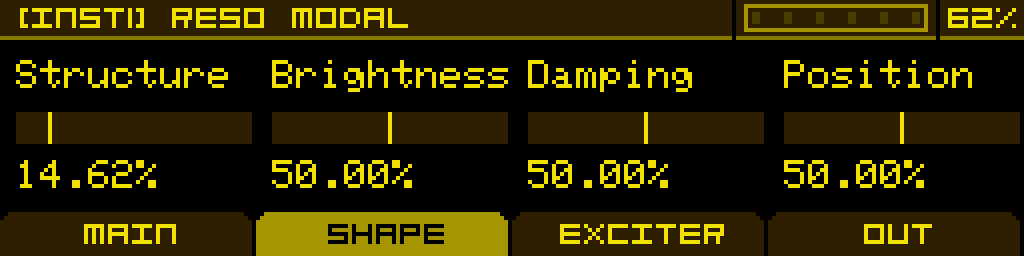
The Machine is organised around four UI tabs: MAIN (model and tuning), SHAPE (resonator behaviour), EXCITER (how the resonator is excited) and OUT (drive and output level).
MAIN tab
This is the page you land on when opening the Resonator. It selects the resonator model and sets up the global tuning of the voice.
| Model | Frequency | Transpose | |
| Selects the physical-modelling algorithm used by this voice. There are 19 models, each describing a different resonant object (modal banks, strings, membranes, bells, plates, gongs…). See the Resonator models section below for the full list. | Fine tunes the voice (±24 semitones). Useful to detune voices against each other for chorusing, beating effects, or to stack a sub. | Coarse tune in semitone increments (±48 semitones). Combine with Frequency for octave drops or paraphonic intervals. |
SHAPE tab
Four parameters that morph the resonator's behaviour. Their exact effect varies per model — Structure on a Modal bank reshapes the harmonic series, while on a String it does nothing. Tweak and listen.
| Structure | Brightness | Damping | Position |
| Reshapes the resonator's spectrum — the exact effect depends on the model. On Modal: stiffness (clean harmonic series → bell-like inharmonic). On Inharmonic: bell ratios → plate ratios. On Membrane: raw → tensioned drumhead. On String: dispersion/stretch — neutral around 25%, compresses the partials below that and stretches them like a real piano string above. On Sympathetic: tunes the second sympathetic string against the played note (octave below → unison → fifth → octave → twelfth → double octave). Most other models also use Structure to vary their internal harmonic profile — sweep it and listen. | Controls high-frequency content and how it decays. Lower values give a darker, more damped tone; higher values bring out shimmer. | Sets the overall decay time of the resonator. Higher values give a long sustain (singing bowls, sympathetic strings); lower values produce a short, percussive ring. | Excitation point along the resonator. On Modal: shifts which modes get the most energy. On String: pluck position along the delay line — center for round, edge for thin and bright. |
Tip: Damping and Brightness are the two parameters that change the most dramatically across models. When auditioning a new model, sweep them first to find its personality.
EXCITER tab
The Resonator is silent on its own — it needs energy injected into it. This tab exposes three excitation layers that can be stacked freely (a bowed plate with a pluck on top, a blown string with a periodic mallet…). The tab has two pages.
Page 1 — Levels
| Bow | Blow | Strike | Envelope |
| Friction-based, sustained excitation (stochastic particles). Use for bowed strings, singing-bowl-like sustains. | Wind-style noise + tube waveguide excitation. Use for breathy, organ-like sustains. | Percussive transient that triggers on note-on. Default at 100% — this is the workhorse exciter (pluck, mallet, hit, sample…). See Strike modes for the 11 sub-types. | Shape of the excitation amplitude over time. 0 = sharp percussive (fast attack, fast decay). 1 = sustained (slow attack, held while the note is gated). Use to morph between hit and bow-style behaviour for the same exciter. |
Page 2 — Color
| Bow Timbre | Blow Timbre | Strike Timbre | Strike Mode |
| Lowpass cutoff applied to the bow output — controls how dark or bright the friction noise sounds. | Mixes the noise / waveguide balance for the blow exciter — from a pure noise blow to a more harmonic tube-like sound. | Hardness / character of the strike. The exact mapping depends on the active Strike Mode (mallet softness, particle roughness, bounce damping, FM index, chirp sweep rate, sample LP/HP filter…). | Selects the strike algorithm. The parameter is continuous: each ~10% zone selects one of the 11 modes, and the position within the zone is a variation of that mode (it tweaks an internal parameter — it does not blend with the neighbouring modes). See Strike modes below. |
When Strike Mode is set to Sample or SmpEnv, a long-press on the EXCITER tab opens a "Load sample" menu that lets you browse the SD card and pick a .wav file as the strike source.
OUT tab
| Drive Type | Drive Amount | Tune Ref | Volume |
| Selects the post-resonator drive curve. 30 algorithms available — same family as the global Drive (Soft, Tube, Sigmoid, Tape, Fuzz, Chebyshev, Asymm, BitReaper, Bitwise, RingMod…). Set to Off to bypass the drive stage entirely. | Drive intensity (0–100%). Disabled while Drive Type is Off. | Toggle a reference sine tone at the voice's base note. Handy for tuning the resonator against an external source — turn it off before recording. | Output level of the voice with a VU meter. 100% is unity gain; higher values can intentionally clip the downstream filter or amp stages. |
Resonator models
The Resonator ships with 19 models, organised in three internal families: modal banks (parallel resonant filters), string-style (Karplus-Strong delay lines), and special physics (custom implementations for membranes, bells, gamelan, kalimba, etc.).
| Model | Character | Best for |
| Modal | Bank of parallel resonant modes with adjustable stiffness. Structure morphs the harmonics from a clean series to bell-like inharmonic ratios. | Versatile starting point — cymbals, plates, generic metallic resonances. |
| Sympathetic | Two coupled strings per voice with internal LFO modulation. Adds a secondary, breathing resonance layer. | Sitar-like drones, vibraphones, sympathetic-string textures behind a melody. |
| String | Single Karplus-Strong delay line with damping filter, allpass dispersion, and soft-clipped bridge. Full-physics plucked string. | Guitars, harps, any clean plucked-string sound. |
| Inharmonic | Bell- and plate-style metallic spectrum. Structure interpolates between bell ratios (0.56–7.69) and plate ratios (1.0–27.83). | Short, sharp metallic clangs. |
| Membrane | Circular drumhead with tensioned-membrane modal ratios. Pitch shifts up as energy rises (the "doof" of a real drum). | Timpani, kicks, taut drum heads. |
| Bars | Harmonic bar resonator (tuning-fork-like). Bright, ringing tone. | Vibraphones, chimes, metal bars. |
| Glass | Refined, glassy modal palette. Crystalline tones, wine-glass-style texture. | Pairs well with sustained bow excitation; sound design textures. |
| Odd Harmonics | Modal bank with only odd harmonics active (1st, 3rd, 5th…). Square-wave-ish character. | Hollow tubes, wooden resonances, pan-pipe shapes. |
| Bell | Pre-shaped warm bell spectrum. Less aggressive than Inharmonic. | Gentle bells, church bells, wind chimes. |
| Tibetan Bowl | Sustained singing-bowl model with a slow internal modulation that comes out on release. Strike Timbre warms or cools the bowl. | Ambient pads, meditation tones. |
| Chladni | High-inharmonicity Chladni-plate patterns (the sand-pattern resonances). Exotic, plate-like, slightly dissonant. | Texture pads and modular drones. |
| Gamelan | Gong-like with a decaying burst on strike followed by an underlying shimmer. Trigger-responsive: hit it harder for a different colour. | Gamelan gongs, tam-tam textures. |
| Primes | Modes tuned to prime-number ratios (2, 3, 5, 7, 11…). Pipe-like, slightly off-kilter. | Pipe organs, experimental drones. |
| Tubular Bell | Orchestral tubular bell with a defined pitch and a metallic shimmer. Trigger-responsive strike. | Orchestra hits, tubular chimes. |
| Kalimba | African thumb piano: plucked decay, body buzz filter, slight pitch glide on attack. Trigger and release responsive. | Warm, woody pluck — kalimba, mbira, thumb piano. |
| Gong | Large tam-tam gong simulation. Complex, decaying shimmer with strong sensitivity to strike strength. | Crashes, wide gongs, modular drones. |
| Tuning Fork | A pure tuning fork — minimal damping, harmonic pair. Ringing, sine-like resonance. | Tuning reference, clean partial in a layer. |
| Balafon | West African wooden bar coupled to a Helmholtz gourd resonator with a mirliton buzz filter. Trigger and release responsive. | Warm, woody, rhythmic — balafon, marimba, wooden percussion. |
| Wood Block | Ultra-percussive wooden block (temple block). Very short decay, sharp attack. | Wood blocks, claves, sticks-on-wood transients. |
Strike modes
The Strike exciter is the most expressive of the three layers and offers 11 sub-modes selected via the Strike Mode parameter on the EXCITER → Color page. The parameter is continuous: each ~10% zone selects one mode, and the position within that zone is a variation of that mode (it nudges an internal parameter — there is no blending with the neighbouring modes).
| Mode | Description |
| Default | Picks the optimal strike type for the currently selected resonator model (a hardcoded lookup — typically Pulse, Pluck, or Mallet depending on the model). Start here when auditioning a model. |
| Pulse | Single sharp impulse, brightness-shaped through a lowpass. Minimal click — the cleanest way to ring a resonator. |
| Pluck | Comb-filtered noise burst with optional plectrum-style damping. Realistic plucking — strings, harps. |
| Mallet | Soft mallet head with configurable contact duration. Gentler than Pulse, with a body. Ideal for vibraphones, marimbas, rubber-headed bells. |
| Particles | Stochastic bouncing/tumbling sound with a chaotic decay. Granular, textured strike — great for unusual percussion and sound design. |
| Brush | Bandpass-filtered noise burst with fade-out. Broad-band brush/swish — perfect for cymbals brushed with mallets, soft snare hits. |
| Bounce | Deterministic repeated decay envelope (configurable restitution). Simulates a ball or stick bouncing on the resonator. Realistic flam-and-roll patterns. |
| FM Burst | Short FM-modulated sine that sweeps down. Gives the resonator a harmonic punch with a tonal attack. |
| Chirp | Frequency-swept sine with configurable sweep rate. Musical slide attacks — useful for synth-like risers and pitched whoosh strikes. |
| Sample | Plays a one-shot WAV file from the SD card as the strike source. Variable playback speed (0.25× to 4×). Strike Timbre applies a configurable lowpass-then-highpass filter sweep across the sample. Use the long-press menu on the EXCITER tab to load a sample. |
| SmpEnv | Same sample loader as Sample, but the raw sample is decayed quickly (~5 ms) and a procedural noise envelope is layered on top. Gives you the punch of the sample plus a controllable resonator tail. |
Tip: within each mode's zone the parameter sweeps a hidden variation of that mode (e.g. mallet softness, particle roughness, chirp sweep rate). Modulating Strike Mode with a Shape sequencer or LFO inside a single zone gives subtle evolving textures; modulating across zones cycles through different strike algorithms.